Tips & Tricks
OSHA-Compliant Mold Reports: Property Manager Liability Guide
Learn how commercial property managers use data-driven mold inspections and OSHA-compliant reports to mitigate liability and protect tenant health effectively.
In this article
Data Over Guesswork: How Commercial Property Managers Mitigate Mold Liability with OSHA-Compliant Reports
Commercial property managers face immediate legal and financial threats when a trigger event—such as a burst pipe, persistent roof leak, or tenant health complaint—sparks a commercial mold outbreak. When occupants report musty odors or physical symptoms, the clock immediately starts ticking on your liability. Ignoring or mishandling these triggers can lead to severe operational disruptions, structural rot, and costly tenant lawsuits.
To protect occupant health and establish a data-driven defense against legal claims, securing an OSHA compliant mold report is absolutely essential. This comprehensive guide explores how property managers can use empirical evidence and independent testing to navigate commercial property mold compliance and mitigate liability effectively.
OSHA Compliance Baseline
An OSHA-compliant commercial mold assessment aligns with federal safety guidelines to ensure workplace and tenant safety. It establishes a baseline of empirical data on indoor air quality, provides visual documentation of moisture intrusion, and delivers actionable remediation protocols designed to protect human health while strictly limiting property owner liability.
The Separation of Church and State in Mold Management: Avoiding Conflicts of Interest
The foundation of mitigating mold liability in a commercial property is securing independent commercial mold testing. This means hiring a dedicated assessment firm that solely inspects and tests for mold, functioning completely separate from the company performing the physical cleanup and demolition.
Property managers must never use their remediation contractor for OSHA compliance testing. Relying on the same contractor to find the problem, fix the problem, and verify their own work creates a massive conflict of interest. It opens the door to inflated scopes of work, unnecessary demolition, and questionable testing results designed to maximize the contractor's profit rather than solve your problem.
By utilizing an inspection-only service, property managers receive unbiased truths without the pressure of upselling remediation services. This strict "separation of church and state" in mold management ensures that the resulting commercial building mold assessment is objective, legally sound, and focused entirely on identifying the root cause of moisture intrusion.
Empirical Data as a Legal Shield: Securing an OSHA Compliant Mold Report
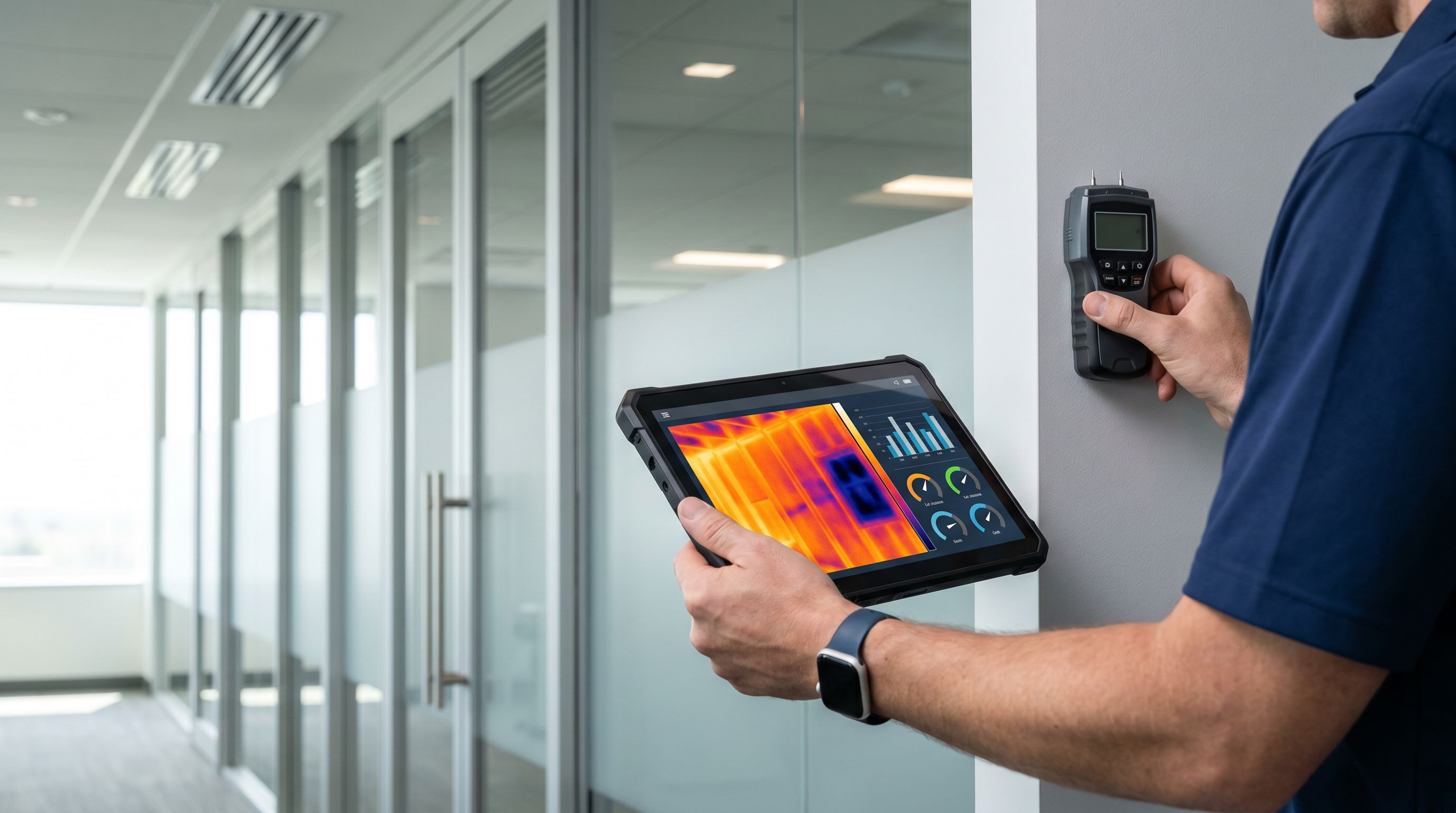
Visual guesswork is no longer sufficient to protect a commercial real estate asset. Premium commercial mold inspection services utilize advanced technology, such as thermal imaging and advanced moisture mapping, to detect hidden water damage behind walls and under floors. This provides visual, empirical evidence of the problem's exact scope, rather than relying on a simple flashlight inspection.
Beyond moisture detection, mold air quality testing commercial protocols must include lab-backed metrics. By aligning with federal guidelines, such as the OSHA SHIB 03-10-10 (A Brief Guide to Mold in the Workplace), these metrics form a bulletproof legal document to mitigate mold liability commercial property owners face.
Furthermore, integrating the compliance framework from the EPA's Guide to Mold Remediation in Schools and Commercial Buildings ensures that your remediation plan includes vital steps to fix the root moisture problem, preventing recurrence. A comprehensive report correlates environmental data to physical building conditions, acting as a legal shield that proves to tenants, insurance adjusters, and regulatory bodies that you took calculated, data-driven steps to ensure safety.
Real-World Scenario: Stopping Liability in Its Tracks
Example: A 50,000 sq ft office building reports water damage on Floor 3 after a roof leak. Within 24 hours, ProDetect deploys thermal imaging to map moisture behind walls. This rapid response provides the property manager with an empirical map of the damage, preventing unnecessary demolition by contractors and providing a highly precise, unbiased scope of work for the remediation crew.
The 24-Hour Rule: Rapid Response to Stop Active Water Damage
When dealing with active water damage or tenant health complaints, property managers have zero tolerance for delays. The "24-hour rule" dictates that rapid response is critical to halting active moisture intrusion and minimizing immediate legal liability.
Why 24-Hour Response Matters: Cost Impact
Mold colonies can begin growing rapidly within 24 to 48 hours of water exposure. A 1-day delay in moisture detection and mitigation can equal thousands of dollars in additional mold colony growth, structural damage, and extended business interruption. Rapid detection stops this exponential cost curve in its tracks.
Fast lab results and immediate on-site assessments are vital to asset preservation. Rapid inspections ensure that the root cause—whether a hidden plumbing leak or HVAC condensation issue—is identified before it compromises the entire building envelope. Once complete, property managers can hand unbiased remediation protocols directly to third-party contractors, limiting the scope to exactly what is necessary and effectively controlling repair costs.
Closing the Liability Loop: Post-Remediation Verification (PRV)
Even after a remediation crew has finished tearing out contaminated materials and cleaning the space, the job is not legally complete. Post remediation verification testing (PRV) is the mandatory final step required to legally prove that a remediation contractor successfully made the building safe for re-occupancy.
Skipping PRV testing leaves the property manager incredibly vulnerable. Without this final legal document, there is no empirical proof that the indoor air quality has returned to normal baseline levels or that the mold hazard was entirely eradicated. PRV officially closes the liability loop.
Liability Mitigation Checklist
Commercial property managers should follow this proven protocol to ensure complete compliance and asset protection:
- Hour 0-24: Dispatch assessment: Dispatch an independent, inspection-only professional within 24 hours of the initial trigger event.
- Day 1-3: Receive OSHA report: Obtain empirical lab data, thermal heat maps, and clear, unbiased remediation protocols.
- Day 4-14: Third-party remediation: Hire a separate contractor to execute the precise scope of work outlined in the independent report.
- Day 15: PRV testing: Conduct final air and surface testing to legally document the restoration of a safe environment.
Protect Your Property with ProDetect Mold Inspection
Mitigating mold liability requires a proactive, data-driven approach. By insisting on independent inspections, leveraging advanced detection technology, and securing an OSHA-compliant report, commercial property managers can confidently protect both their physical assets and their occupants' health.
Don't leave your commercial property's safety to guesswork or conflicted contractors. ProDetect Mold Inspection provides unbiased, highly accurate (99.8%) commercial mold assessments without any conflict of interest. Operating across 170+ U.S. locations, our certified professionals deliver the rapid response and empirical data you need to manage liability.
Schedule your 24-hour rapid assessment today. Visit us at www.prodetectmold.com, call 833-659-3463, or email hello@prodetectmold.com.