Health & Safety
Mold Myths Debunked: Science-Based Home Protection Guide
Discover 6 dangerous mold myths that could cost you thousands. Learn science-backed facts about mold removal, bleach effectiveness, and moisture control from experts.
In this article
6 Common Household Mold Myths Busted: A Data-Driven Guide to Protecting Your Home
You know that sinking feeling all too well. You walk into your home, take a deep breath, and catch a whiff of something undeniably musty. Or perhaps you or your family members have recently started experiencing unexplained allergy symptoms, persistent headaches, or chronic fatigue that magically disappear the moment you leave the house. Panic immediately sets in. Your home is supposed to be your safe sanctuary, not a source of illness or a depreciating asset.
When property owners suspect a fungal issue, their first instinct is usually to turn to the internet for answers. Unfortunately, a quick search yields a chaotic mess of conflicting advice, scare tactics, and DIY remedies that often do more harm than good. In an industry plagued by guesswork and sensationalism, it is incredibly easy to fall victim to common mold myths that can cost you thousands of dollars and jeopardize your family's health.
At ProDetect Mold Inspection, we believe in prioritizing data over drama. With over 24 years of experience and more than 200,000 completed inspections, we know that protecting your property and your peace of mind requires empirical evidence, not emotional reactions. You need scientific proof, advanced detection technologies, and unbiased truths to make informed decisions. Let us clear the air by debunking the most pervasive myths about indoor mold, using hard facts to help you protect both human health and your property value.
Myth #1: Bleach is the Ultimate Mold Killer
If you spot a dark patch of fungal growth in your bathroom or basement, your first reaction might be to grab a bottle of household bleach. It is one of the most frequently asked questions we hear: does bleach kill black mold? The short, scientific answer is no. While bleach is a powerful chemical, it is entirely ineffective at resolving a true mold infestation on porous surfaces like drywall, wood, or insulation.
When you apply bleach to a porous surface, the chlorine stays on the outside while the water content penetrates deep into the material. The bleach simply removes the color from the surface mold, making it invisible to the naked eye and tricking you into thinking the problem is solved. Meanwhile, the microscopic roots (mycelia) are left completely intact beneath the surface. Even worse, the water from the bleach actually feeds those roots, allowing the fungus to return stronger and faster than before.
More importantly, trying to chemically "kill" mold completely misses the root cause of the problem. Treating the visible symptom is utterly useless if you ignore the underlying moisture intrusion. According to the U.S. Environmental Protection Agency's Ten Things You Should Know about Mold, the only effective way to manage and prevent indoor mold is to control indoor moisture. Until you find and fix the hidden leak, condensation issue, or structural vulnerability, the mold will inevitably return. True asset preservation requires identifying the source of the water, not just bleaching the stains it leaves behind.
Myth #2: If You Can't See It or Smell It, Your Home is Safe
One of the most dangerous misconceptions is the "out of sight, out of mind" approach. Many property owners assume that if their walls look clean and their home smells fresh, they are completely safe. This invisible threat angle is a major blind spot. In reality, mold thrives in dark, damp, and hidden spaces. By the time it becomes visible on your baseboards or ceilings, the infestation behind the drywall is usually extensive.
Because you cannot always rely on your eyes or nose, it is vital to pay attention to hidden mold symptoms. Occupants might experience chronic coughing, sneezing, skin irritation, or brain fog that cannot be attributed to seasonal allergies. These physical symptoms are often the first true indicators that something is wrong within the building envelope. Unfortunately, the physical signs of mold behind walls are often completely undetectable to the naked eye or a standard contractor's flashlight.
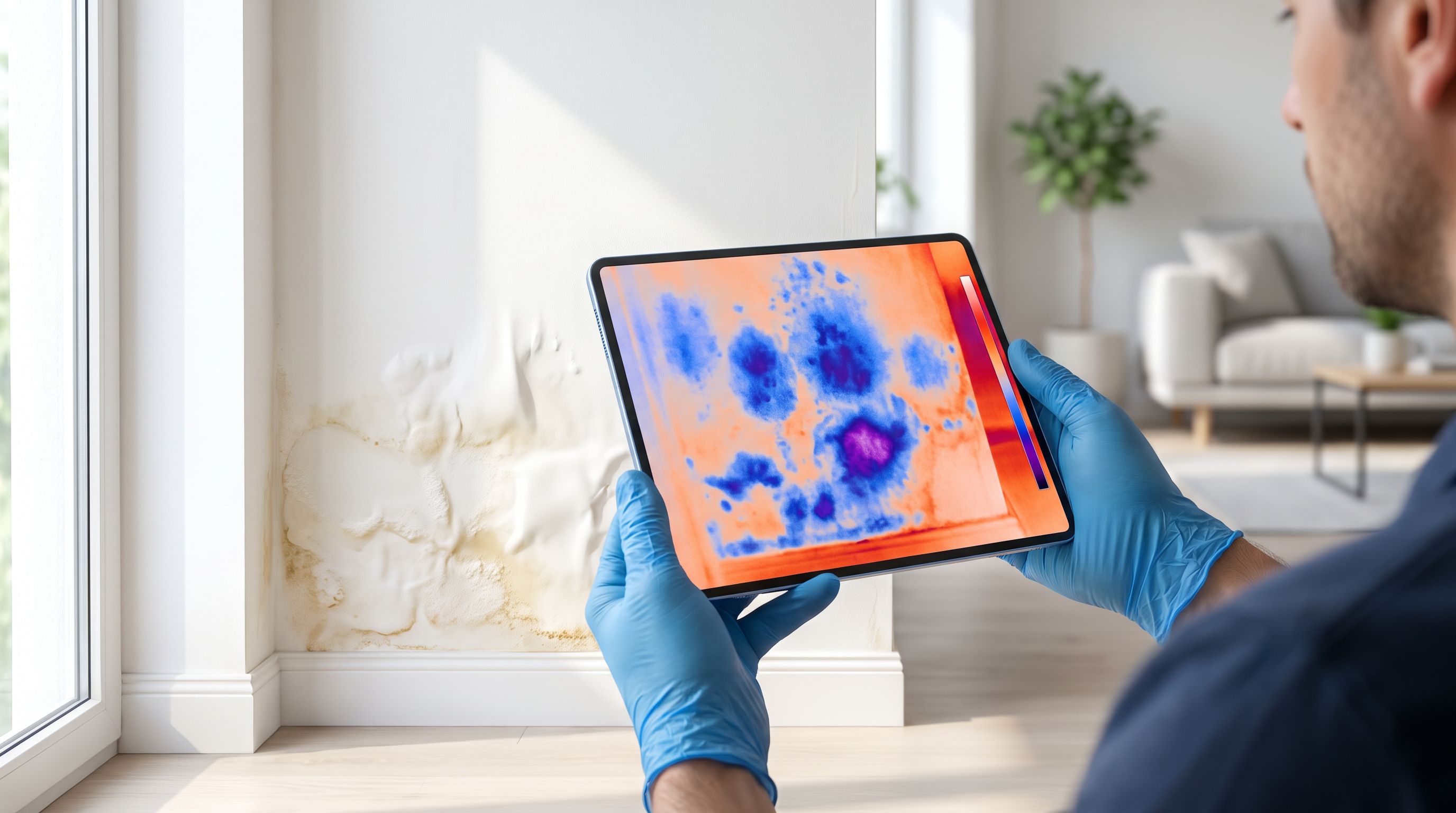
This is where technological assurance becomes non-negotiable. Professional inspectors do not just guess where the moisture might be; they use advanced science to find it. At ProDetect Mold Inspection, we utilize state-of-the-art thermal imaging mold detection and advanced moisture meters to scientifically locate hidden water damage. Thermal cameras detect minute temperature differences behind your walls, allowing us to map out moisture intrusion without unnecessarily tearing down your drywall. This data-driven approach validates your concerns with empirical evidence, proving exactly where the moisture is hiding.
Myth #3: All Mold is Toxic "Black Mold"
The media has done an excellent job of terrifying homeowners with sensationalized stories about "toxic black mold." As a result, finding even a single spot of dark mold can send a property owner into a spiral of anxiety. While it is true that certain types of mold can produce harmful mycotoxins, the reality is far more nuanced. We need to choose data over drama to accurately assess the risk to your household.
First, it is crucial to understand that not every dark-colored fungal growth is the infamous Stachybotrys chartarum. There are over 100,000 species of mold in the world, and many common household varieties are dark in color but pose minimal severe health risks compared to true toxic strains. Furthermore, there is a critical difference between visible surface mold and invisible airborne spores. You could have a small patch of visible surface mold that is relatively contained, or you could have entirely hidden mold that is pumping millions of microscopic spores into your HVAC system, causing severe indoor air quality issues.
To truly understand what you are up against, you need comprehensive indoor air quality testing for mold. Using advanced air sampling pumps, our certified specialists capture airborne spores and send them to an independent laboratory for microscopic analysis. With an impressive 99.8% accuracy rate, we can identify exactly which of the 50+ common indoor mold types are present in your home, and in what concentrations. This allows you to correlate environmental data with your family's physical health symptoms, giving you the exact scientific proof you need to consult with your physician or take targeted action.
Myth #4: You Should Hire the Same Company to Test and Remove Your Mold
If you take away only one piece of advice from this guide, let it be this: never hire the same company to inspect your mold and remediate it. This is the biggest conflict of interest in the indoor environmental industry, and falling for this myth can cost you dearly. It is vital to understand the distinct difference between mold inspection vs remediation.
Think about it logically: if a contractor makes their money by tearing out drywall, running expensive dehumidifiers, and applying chemical treatments, they have a massive financial incentive to "find" a severe mold problem in your home. Letting the company that diagnoses your problem also profit from the expensive teardown and repair is a massive red flag. It often leads to sensationalized findings, unnecessary demolition, and grossly inflated invoices.
You need a partner who will give you the hard truth without sugarcoating it, but also without sensationalizing the findings to cause panic. That is why ProDetect Mold Inspection operates strictly as an unbiased, inspection-only service. We reject any kickbacks from affiliated remediation organizations. Our only goal is to provide you with a transparent, highly accurate, and legally sound report. Our comprehensive reporting is detailed enough for an insurance adjuster or a remediation crew to follow, yet clear enough for a layman to understand. By separating the testing from the removal, we protect your wallet just as fiercely as we protect your health.
Myth #5: Hardware Store DIY Mold Kits Are Just as Good as the Pros
Walk into any local hardware store, and you will find shelves lined with cheap, petri-dish-style mold testing kits. They promise quick answers for a fraction of the cost of hiring a professional. However, these over-the-counter kits are notoriously unreliable and are widely criticized by indoor air quality scientists.
Here is the scientific reality: mold spores are a natural part of our environment. They are present in the air everywhere, both indoors and outdoors. If you open a petri dish in a perfectly healthy home, mold will eventually settle on the nutrient-rich gel and grow. These cheap kits almost always yield false positives because they do not measure the volume of air, nor do they compare indoor spore counts to an outdoor baseline. They simply tell you that mold exists—which is already a scientific fact—causing unnecessary panic without providing any actionable data.
True asset preservation and health validation require professional mold testing. Professional air quality testing utilizes calibrated pumps that draw a specific volume of air over a specific time, allowing a laboratory to calculate the exact concentration of spores per cubic meter. This yields 99.8% accuracy and rapid lab results that serve as actionable documentation for landlords, insurance adjusters, or remediation crews. For property owners who prefer to take the first step themselves, ProDetect offers professional-grade mold test kits for DIY enthusiasts. Unlike hardware store gimmicks, our kits come complete with expert guidance, support, and scientific lab analysis, ensuring you get real data you can trust.
Myth #6: You Only Need to Worry About Mold After a Major Flood
Many homeowners operate under the assumption that unless their home has suffered a catastrophic event—like a burst pipe, a flooded basement, or a hurricane—they do not need to worry about mold. This reactive mindset is dangerous. While major water disasters certainly cause severe fungal growth, the vast majority of mold issues stem from slow, chronic, and entirely unglamorous moisture problems.
A slow pinhole leak behind a shower valve, poor ventilation in a crawlspace, or chronic condensation on poorly insulated windows can easily provide enough moisture to sustain a massive mold colony. In fact, these slow-drip scenarios are often worse than a major flood because they go unnoticed for months or even years. The structural rot and airborne spore contamination compound silently, significantly devaluing your real estate and compromising your indoor air quality.
Asset preservation requires a proactive approach to moisture management. You do not need standing water to have a mold problem; you only need elevated relative humidity. By utilizing our advanced moisture detection services and thermal inspections, we can identify these micro-leaks and humidity traps long before they rot your framing or trigger severe allergic reactions. Catching the root cause early is the ultimate key to protecting your property investment.
Get the Hard Truth About Your Indoor Air Quality
Protecting your home and your family requires scientific, unbiased facts, not internet rumors or the guesswork of conflicted contractors. Whether you are trying to correlate physical health symptoms with environmental data, document a problem for an insurance claim, or simply ensure your property is safe from hidden structural rot, you need a partner who relies on advanced technology and empirical evidence.
At ProDetect Mold Inspection, our core mission is to protect human health and property value through complete transparency. With service availability across 170+ U.S. locations, rapid response times, and a 100% customer satisfaction guarantee, we are ready to provide the clarity and honesty you deserve. Do not let mold myths dictate the safety of your sanctuary.
Take control of your indoor air quality today with a 100% accurate, conflict-free assessment. Visit us online at https://www.prodetectmold.com, call our certified experts directly at 833-659-3463, or reach out via email at hello@prodetectmold.com to schedule your professional mold inspection or order a professional-grade test kit.