How-To Guides
How to Estimate Mold Age and Trace It to Its Source
Learn how to estimate when mold growth began, build a defensible event timeline, and trace moisture to its hidden source with this step-by-step guide.
In this article
How to Determine the Age of Mold: A Step-by-Step Guide to Estimating When Growth Began and Tracing It to the Source
A homeowner or landlord finds a dark patch on drywall and needs to know one thing fast: did it appear last week, or has it been developing for months? The honest answer is that mold age is estimated, not dated to the day. A credible estimate, however, gives a likely range and a confidence level, and it can link growth to a specific leak, flood, or date of loss. This guide walks through the steps that make that estimate defensible.
Step 1: Gather Prerequisites and Build Your Event Timeline
Before any inspection, collect the records that establish when things changed. Useful materials include dated photos, repair invoices, water bills, prior inspection reports, lease or purchase documents, and notes on odors, leaks, or occupant symptoms. Water bills can reveal unexplained usage spikes that suggest a hidden leak, and prior reports can show whether the area was previously clean.
Next, record the known or suspected moisture event, such as a roof leak, appliance failure, or flood, along with the date it was discovered. Mold age is most useful when it is tied to a water event, because the event supplies a fixed starting point for the analysis.
Common mistake: relying on memory. Write down dates and observations as they happen. A contemporaneous log carries far more weight with an adjuster or a court than a reconstruction made weeks later.
Step 2: Assess Visible Signs and Identify the Mold Type
Color and texture alone are unreliable age indicators. Surface appearance changes with humidity, cleaning, paint, and the material the growth sits on. A fresh colony can look old, and an old one can look freshly wet after a recent disturbance. Treat visual impressions as a starting hypothesis, not a conclusion.
Professional identification relies on direct microscopic examination by a mycologist, which is the primary method for determining whether mold or other fungi have grown on a particular surface. Identifying the genus and species helps frame the conditions that supported growth, such as the moisture level and duration needed for that organism to establish itself.
Age is estimated from multiple indicators together, including the mold type, the moisture history, and the materials involved. For that reason, findings should be presented as a likely range, such as weeks versus months, rather than a precise date. Any report that promises an exact date should be treated with suspicion.
Step 3: Locate the Hidden Source and Separate Active from Historical Moisture
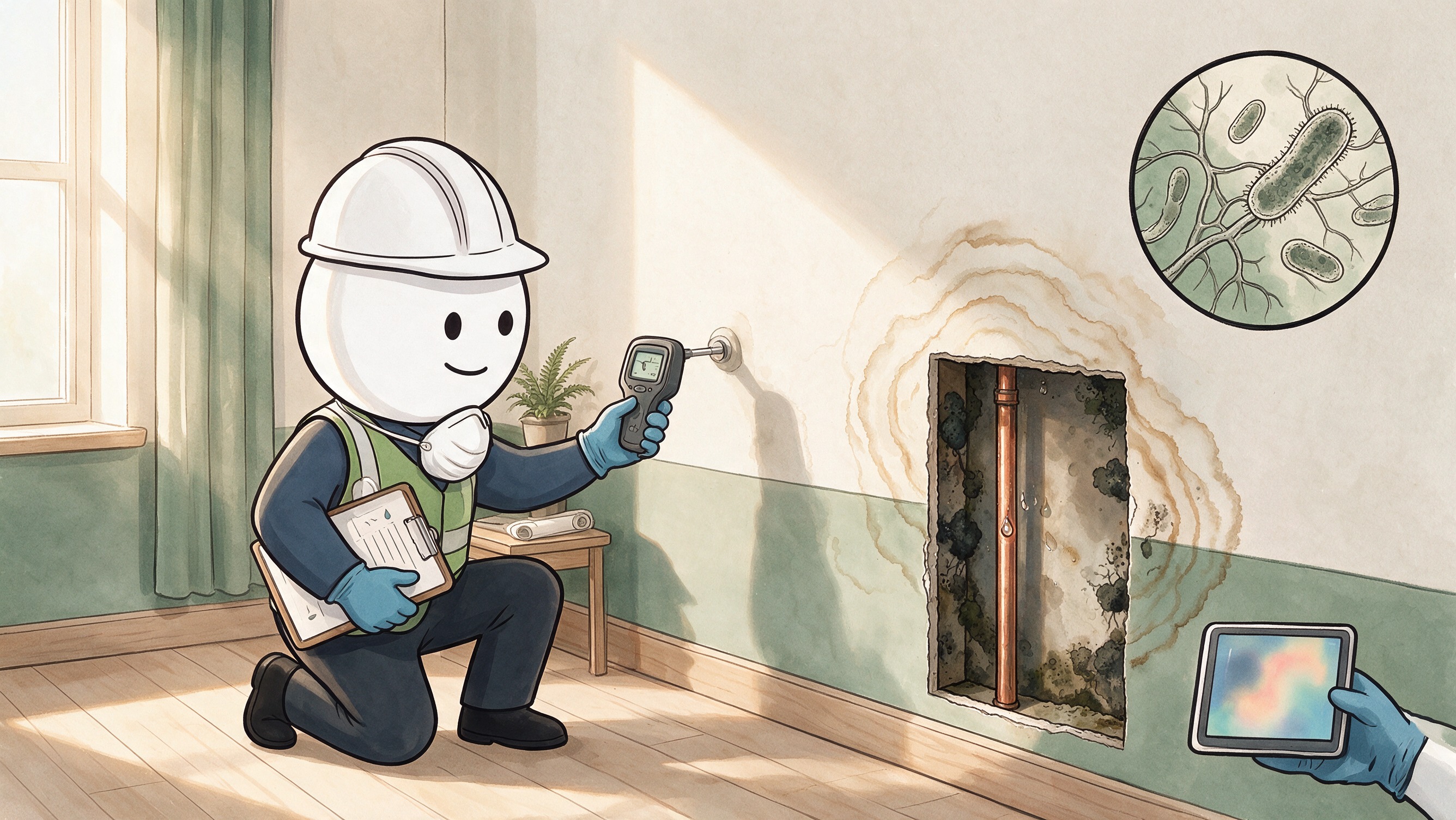
Surface growth is often a symptom of water moving somewhere else. Moisture mapping, moisture meter readings, and thermal imaging help locate where water is currently moving or has left a lasting footprint behind walls and under flooring. Thermal imaging highlights temperature differences that can indicate moisture, while meter readings quantify it at specific points, so the two methods are most informative when used together.
Connect the estimated age range to the moisture source. Growth that aligns with the event date points to that event. Older growth, or growth with staining and deterioration that predates the event, may indicate a longer-running leak that was never reported. Active moisture, confirmed by elevated readings that persist, calls for immediate correction, while historical moisture may show only dried staining.
Interpret sampling results carefully. Swab and tape results are grouped into Stage 1 (Trace) through Stage 4 (High). Spore trap air samples are compared against indoor reference ranges, where Stage 1 (Trace) is less than 500 spores per cubic meter of air, Stage 2 (Low) is 500 to 1,500, Stage 3 (Moderate) is 1,500 to 3,000, and Stage 4 (High) is more than 3,000. These are reference guidelines, not regulatory limits, and they must be read alongside mold type, extent of growth, and occupant health.
Tip: a single sample rarely answers the question. Compare indoor results with outdoor background levels and with samples taken from a control area to see whether the indoor reading stands out.
Step 4: Document the Findings for Insurance, Landlords, and Remediation
A complete report should include a dated timeline, a photo log, moisture readings, thermal images, sample results with stage interpretations, and a clear statement of the estimated age range and its confidence level. Each element should be dated and tied to a location so that an adjuster can follow the reasoning and a layperson can understand the conclusion.
An age-linked timeline supports insurance claims by documenting when a loss likely occurred. It supports lease and landlord disputes by showing whether a condition existed before or after a tenant's move-in or a repair request. It also informs pre-purchase negotiations and date-of-loss documentation, where the question is whether damage predates the transaction.
The role boundary matters. An inspection-only provider identifies and documents conditions but does not perform the remediation. This separation reduces conflict of interest, because the party reporting the problem is not the party paid to fix it. Remediation typically follows comprehensive testing and generally includes air scrubbing, antimicrobial treatment, removal of materials that cannot be salvaged, humidity control with fans and dehumidifiers, and post-remediation re-testing. A certified and licensed contractor should perform this work.
Recap and Next Steps
Estimating mold age comes down to four steps: gather records and build a dated timeline, assess visible signs and mold type while respecting the limits of each indicator, locate the moisture source and separate active from historical water, and document everything in a report that states its confidence level. Each step makes the next one more reliable.
If you need an unbiased, inspection-only assessment, contact ProDetect Mold Inspection. The team can document conditions, estimate growth timing, and provide a report built for insurers, landlords, and remediation crews. To help you prepare, request our downloadable field checklist, which covers what to photograph, record, and note before a visit. Visit https://www.prodetectmold.com, call 833-659-3463, or email hello@prodetectmold.com.